




Search for a bilingual Santa letter service and many results are worksheets, editable templates, or teaching resources rather than a managed service that writes and sends two personalized language versions.
That gap exists because bilingual letters are harder than they look, and the difficulty is not the translation. It is that a letter has to name the right gift-giver, land on the right date, and use the register a child actually hears at home. Get any of those wrong and the letter reads like a stranger wrote it, which is precisely the opposite of what you paid for.
Key Takeaway
A bilingual Santa letter should be designed around the child’s reading ability and the household’s traditions, not produced by translating an English template word for word. Confirm the name used for Santa, the family’s gift-giving date, the preferred language format, and who will read the letter aloud before ordering.
What a Bilingual Santa Letter Service Must Get Right
A translated letter says the same thing in another language. A bilingual letter says the right thing for a household that lives in two languages, and those are not the same document.
Consider what the letter has to know. Which language does the child read most comfortably? Which language does the family use for affection? Does the child read the second language, or mainly hear it? A child may speak Spanish at home and still read English more easily. UNESCO’s guidance on multilingual education and first-language comprehension supports the practical point: familiarity with a language does not automatically mean equal reading confidence.
That produces three sensible formats.
| Format | Best fit | Main limitation |
| One language | The child reads one language much more confidently | Other relatives may need help reading it aloud |
| Two complete versions | The child and reading adult prefer different languages | The service must preserve names and meaning across both versions |
| Mixed-language letter | The household naturally switches languages | It requires family-supplied wording and careful proofreading |
The Name Is the Part That Breaks
The gift-giver is not called the same thing in every household, and this is where a well-meaning letter falls apart.
Depending on the country and the family, the figure may be Santa Claus, Papá Noel, San Nicolás, El Niño Dios, or the Reyes Magos, and some families use more than one. Products on the market show the confusion clearly. Editable Spanish Santa letter listings are sold interchangeably as a letter from Santa in Spanish and a letter from Papá Noel, as though the two were the same character with the same voice.
That interchangeability is a design shortcut. A letter written for a household knows which figure visits, when the visit happens, and what the child calls that figure. A fixed, unfamiliar signature makes the message feel borrowed.
The service has to ask: What does your child call him? Not what does your country call him. A customizable signature can preserve that household choice; a fixed sign-off cannot.
Our overview of Santa around the world covers how widely the figure and the traditions vary.
The Date Is the Second Thing That Breaks
Many families exchange gifts on Christmas Eve rather than Christmas morning. Others do the main gifting on January 6 for Three Kings Day, sometimes alongside a smaller Christmas exchange. The Smithsonian notes that in Puerto Rican tradition, children may receive gifts from Los Reyes Magos on January 6.
A letter that says “I will visit on Christmas Eve” is wrong in a household where the visit happens on the sixth of January, and a child who is waiting until January reads that as a mistake. Worse, a letter that promises to come on December 25 sets an expectation the family has no intention of meeting.
The fix is easy once you know to ask for it. Keep the timing soft, or state the date the family actually uses. Soft wording travels across every tradition, which is why it is the safer default when you are not certain.
If you are writing the letter yourself, our letter template and wording bank gives you neutral phrasing you can adapt rather than date-specific lines you have to rewrite.
The Grandparent in the Room
Bilingual letters may have a second reader, and many templates do not plan for that person.
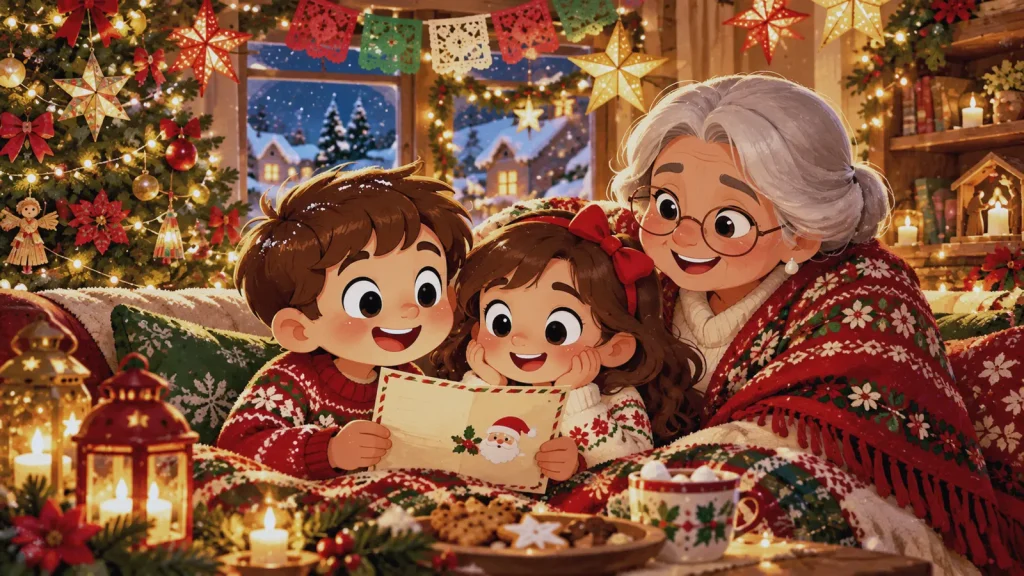
In many households the person who reads the letter aloud is a grandparent, and the person who reads it silently is the child. Those two people often have opposite language strengths. The grandparent reads the home language comfortably and the school language slowly. The child is the reverse.
That is the strongest argument for two versions in one envelope. The adult can read aloud in one language while the child follows the version they decode fastest.
It also changes what you write. If a grandparent will read the letter out loud, keep the sentences short and the names phonetically simple in that language, because a stumbled line breaks the spell more than a translation error on the page. And if the grandparent is the one who requested the letter, ask them what Santa is called before you order, not the parent.
Our overview of what a letter from Santa should include covers the core elements that have to survive in either language.
For families who want a richly detailed English-language option, a personalized Santa letter from Santa’s Magical Kingdom includes your child’s name, hometown, friend’s name, and wish list — making it feel genuinely one-of-a-kind.
The Sign-Off Is the Last Thing to Get Right
Parents spend their attention on the body of the letter and then accept whatever closing the service supplies. The closing is where the letter either sounds like family or sounds like a form.
English Santa letters usually close on love from Santa, and that phrase does not carry the same warmth translated word for word. Households have their own closing, and it is often a diminutive or an endearment nobody outside the family uses. That is the line worth supplying yourself.
If the service lets you set the sign-off, use two lines rather than one. A closing in the home language, then the signature in whatever name the child uses. That combination reads as a person finishing a letter rather than a template ending.
Why Machine Translation Fails Here
Run an English Santa letter through an automatic translator and the result may be grammatically acceptable without sounding familiar to the household. Three areas need a human check.
Register collapses. Warmth in one language does not map word for word onto warmth in another, and translated affection tends to land as formal or oddly stiff.
Address forms break. Languages with formal and familiar second-person forms need the familiar one for a child, and translation tools do not always choose it. A letter from Santa that addresses a six-year-old formally sounds like a letter from a bank.
Names and idioms pass through literally. Nice list, elves, the North Pole workshop, and reindeer names all carry local conventions that differ by country, and a literal rendering reads as foreign rather than magical.
If a seller accepts text in a language its staff cannot read, ask whether the wording will be printed exactly as submitted. Have a fluent speaker check spelling, accents, names, and address forms before the order enters production.
What to Ask a Service Before You Order
Five questions settle it.
- Can I set the name the letter is signed with, or is the sign-off fixed?
- Can I supply my own text in another language, and will you print it exactly as written?
- Does anyone on your team read that language well enough to catch an error?
- Can the letter avoid naming a specific date?
- Can I get two versions, one per language?
If a service answers yes to the first two, you may be able to build a bilingual letter even where no dedicated bilingual product is advertised.
Building the Letter Your Child Will Recognize
The reason bilingual letters matter is familiarity. A letter using the language and endearments a child hears at home can sound more personal than a direct translation of a school-language template.
So start with the name, then the date, then the language of the greeting, and only then worry about the paper and seal. The letters from Santa form collects structured child details and an optional surprise message. Ask the team directly what is possible for a second-language letter before ordering.
Frequently Asked Questions
Is a bilingual Santa letter just a translated letter?
No. A translation repeats the same content in another language. A bilingual letter also accounts for reading ability, family vocabulary, the name used for Santa, and the household’s holiday calendar.
What should a bilingual Santa letter service ask before writing?
It should ask which language the child reads best, which language is spoken at home, what the child calls Santa, and when gifts are exchanged. Those answers determine the format and wording.
When should I order a bilingual Santa letter?
Order early enough to allow a fluent speaker to review both versions before production. If the letter will be mailed, leave additional time for corrections and postal transit.
Who should proofread a bilingual Santa letter?
Use someone fluent in the household’s actual variety of the language. A technically correct translation can still sound formal, regional, or unfamiliar to the child who receives it.
What should the letter call Santa in a Spanish-speaking family?
Whatever the family calls him. That may be Santa Claus, Papá Noel, San Nicolás, El Niño Dios, or the Reyes Magos, and it varies by country and by household. Ask the parent rather than assuming a national default.
Should a bilingual Santa letter mention a specific date?
Usually not. Families exchange gifts on Christmas Eve, Christmas morning, or January 6 for Three Kings Day. Soft wording avoids contradicting the family’s plans.
Can I use Google Translate for a Santa letter?
You can use machine translation as a first draft, but do not treat it as the proofreader. Have a fluent speaker check tone, address forms, holiday terms, names, accents, and the sign-off before printing.
Can I get the same letter in two languages?
Some services may accept two versions or custom text, but this is not universal. Confirm the number of pages, proofreading responsibility, character support, layout, and price before you submit either version.
Is a mixed-language Santa letter better than two full versions?
It can feel more natural when the household regularly switches languages. Two full versions are easier when the child and the adult reading aloud have different language strengths.
Does a bilingual Santa letter cost more?
It may if the order requires two pages, specialist translation, or manual proofreading. Compare the finished format and review process rather than assuming a higher price includes language expertise.
Does Santa’s Magical Kingdom advertise bilingual letters?
The current Letters from Santa form collects child-specific details but does not publicly confirm bilingual production. Ask about language, sign-off, proofreading, and two-version requests before ordering.
What should I prepare before requesting a bilingual letter?
Write the child’s preferred Santa name, gift date, greeting, endearment, and sign-off exactly as they should appear. Then choose one language, two versions, or a mixed-language format.