






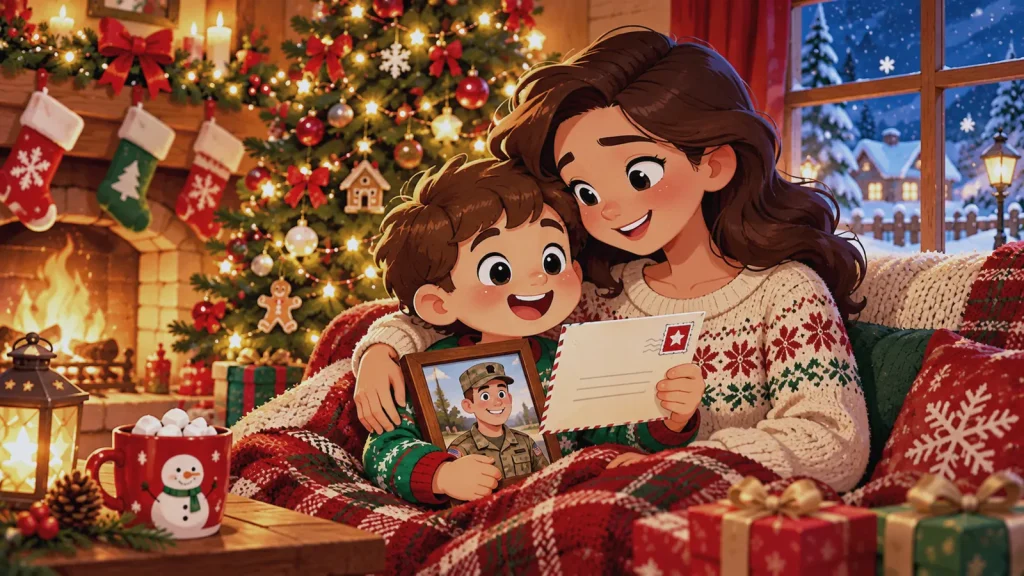
Deployment can change where a family lives, who is home, how Christmas is scheduled, and when mail arrives. A Santa letter can acknowledge those facts without speaking for the child or making promises the family cannot control.
A useful letter reassures the child that Santa knows the current household, recognizes the absent parent in familiar language, and leaves homecoming information to the adults who hold the facts.
Key Takeaway
A Santa letter for a child with a deployed parent should use the family’s own words for deployment, confirm the correct location, mention one supportive personal detail, and avoid promises about gifts, leave, or homecoming. Check military-mail deadlines separately from the date the child’s letter must arrive at home.
What a Santa Letter for a Child With a Deployed Parent Should Do
Start with what the family knows. If the household moved or is staying somewhere temporarily, a line confirming the current town can settle the practical part of the story. Do not print the full street address inside the letter.
Then decide whether the parent’s absence should be named. Use the same terms the child already hears, such as deployed, overseas, on duty, or away for work. Military OneSource advises supporters to stay connected in the way that feels most comfortable for the child and notes that mail, email, or short messages can help. A Santa letter can support that connection, but it should not replace direct family conversation.
If Your Family Celebrates on Another Date
Some military families move the main celebration so the deployed parent can join live, call in, or participate after returning. A Santa letter can support that family plan without claiming that Christmas itself has changed.
Use wording such as, “I know your family has chosen a special day to celebrate together.” State only a date the caregiver has confirmed, and avoid implying that operational plans or leave cannot change. If timing remains uncertain, leave the date out and focus on the family tradition.
Ask the service whether the letter can avoid naming December 25 and whether you can review any date-specific wording before production.
What to Put in the Letter
Four elements, in this order.
Recognition of the parent’s absence, when appropriate. Use deployed, working, overseas, or the words your child already hears. Do not introduce operational details the family has not shared.
Reassurance about the address. Santa knows where you are now.
A specific detail only your household would know. The dog, the new school, the thing they got braver about this year. This is what makes the letter feel observed rather than generic.
A different date, if the caregiver has confirmed one. Present it as the family’s plan, not an unchangeable promise from Santa.
Keep gift language soft. Santa can notice a wish without committing to a specific item. The same rule applies to calls, leave, travel, and homecoming dates.
Our guide to what to write from Santa has structures you can adapt, and the template and wording bank covers openings and sign-offs.
Wording That Supports Without Overpromising
The strongest lines stay close to facts the caregiver controls. Use this check before submitting the message.
| Avoid | Use instead | Why it is safer |
| “Dad will be home very soon.” | “Dad is thinking about you while he is away.” | It offers connection without inventing a return date |
| “You must be brave for Mom.” | “You can talk to Mom when you miss Dad.” | It does not make the child responsible for adult feelings |
| “I will bring the exact gift you asked for.” | “I saw the wish you sent.” | It recognizes the request without guaranteeing fulfilment |
| “I know everything you do.” | “I heard about the effort you made at school.” | It replaces surveillance language with one supportive example |
Read the finished message aloud. Remove any sentence that announces news, assigns the child a duty, or depends on a military schedule. The letter should leave the child with recognition and connection, not a new promise to monitor.
A Letter to the Deployed Parent Too
Consider a separate short note for the deployed parent, but coordinate it with the caregiver and the service member. Keep it supportive, avoid sharing information that should not travel through mail, and check military-post timing before choosing a physical version.
If the Parent Is Coming Home Soon
Some deployments end in January, some in March, and some on a date nobody will commit to. The letter has to handle that honestly, and the temptation is to have Santa promise a homecoming.
Do not promise a homecoming date. Orders, transport, and reintegration plans can change, and the Santa letter should not become the source of a fact the caregiver cannot guarantee.
What works instead is a present-focused message the caregiver can confirm. Santa can say that the parent is thinking about the child, or recognize a message the parent has actually sent. That offers connection without attaching it to a calendar the family does not control.
Even when a return is expected, let the family decide how to announce it. Sesame Street for Military Families notes that homecoming is another transition and that the reality may differ from expectations. Keep Santa’s message supportive and present-focused.
Timing, APO Addresses, and the PCS Problem
Military holiday mail uses service- and destination-specific dates that may be earlier than domestic deadlines.
Mail to APO, FPO, and DPO addresses follows service- and destination-specific schedules. USPS publishes military holiday dates annually; use the current USPS holiday news page and its military mail guidance rather than copying a prior year’s date.
Two practical points. First, do not confuse the deadline for mailing to the deployed parent with the deadline for the letter arriving at home. They are different dates and often several weeks apart. Second, if the family is mid-move, the address on the order form may be wrong by the time the letter arrives. Order to the address the family will be at on the delivery date, not the one they are at today, and if you are unsure, choose a digital letter and print it locally.
If timing has already slipped, a digital or printable letter removes postal transit but may still require production time. The last-minute Santa letter guide covers locally controlled options.
Siblings in a Deployed Household
Children in the same house may understand deployment differently. Do not copy the same paragraph and change only the name.
Match each letter to what that child already knows. Keep the message warm and concrete for an early reader. Use more direct acknowledgment for a child who already asks about the deployment, but do not assign a caregiving role or praise “being strong” unless that language fits the family.
This guidance is also useful for grandparents, unit-family supporters, and other trusted adults preparing a letter on the caregiver’s behalf. The caregiver should still approve the final wording, current address, celebration date, and any reference to the service member before the order is submitted.
Getting the Letter Right
The letter’s job is small and specific. Confirm the current household, acknowledge the parent in familiar language, and support the family’s celebration plan without making promises.
Write those points before opening the order form. Then create your child’s letter from Santa, enter only details the family is comfortable sharing, review the displayed summary, and confirm any date-specific wording before submission.
Frequently Asked Questions
What is a Santa letter for a child with a deployed parent?
It is a personalized holiday letter that recognizes the family’s current situation without turning deployment into a plot device. The wording should follow the caregiver’s language and boundaries.
What should the letter say?
Confirm that Santa knows the current location, mention one supportive personal detail, and acknowledge the deployed parent only in familiar terms. Keep gifts, calls, leave, and return dates unpromised.
When should I order the letter?
Work backward from the reveal date using the service’s production time and home-delivery estimate. Use separate USPS guidance if another letter is being sent to an APO, FPO, or DPO address.
Who should approve the wording?
The caregiver who knows what the child has been told should approve it. When practical, coordinate any message for the deployed parent with that service member as well.
Can the family celebrate on another date?
Yes. The letter can recognize a special family celebration date when it is confirmed. Avoid framing the date as an unchangeable promise from Santa if military plans remain uncertain.
What should the letter avoid?
Avoid homecoming promises, operational details, frightening surveillance language, firm gift commitments, pressure to “be strong,” and private information the child or service member would not want repeated. Keep reassurance warm without pretending Santa knows facts the family cannot confirm.
Should the letter mention deployment directly?
It can when the child already uses that word. Otherwise, use the family’s existing language, such as overseas or away for work. Do not introduce facts the caregiver has withheld.
Is a digital letter better for military families?
It may be better during a move or near the reveal date because local printing removes postal transit. It does not remove the provider’s preparation time or the need for proofing.
How should siblings’ letters differ?
Match each child’s reading level, knowledge, and preferred details. Do not copy the same deployment paragraph or assign an older child extra responsibility unless the family wants that message.
Does mailing to an APO or FPO cost more?
USPS states that military and diplomatic mail uses domestic prices, but service, size, customs, and destination restrictions still matter. Check the current official requirements before mailing.
Can Santa’s Magical Kingdom use deployment details?
Its current form accepts proud moments, behavior details, wishes, location, and an optional friend or sibling. Use concise, non-sensitive wording and confirm any special date or deployment reference.
What should I prepare before ordering?
Write the approved deployment term, current city, one personal detail, any confirmed celebration date, and prohibited topics. Then verify spelling, address, delivery method, and production timing.
When a family’s Christmas looks different this year, the right letter meets the child where they are — not where the template expects them to be. Santa’s Magical Kingdom lets you enter the details your family is comfortable sharing: the current city, a proud moment, a familiar name, and any specific wording the caregiver has approved. The result is a letter written around your child’s real situation, not a seasonal script. Start your personalized letter from Santa with only the details that matter for your family this Christmas.