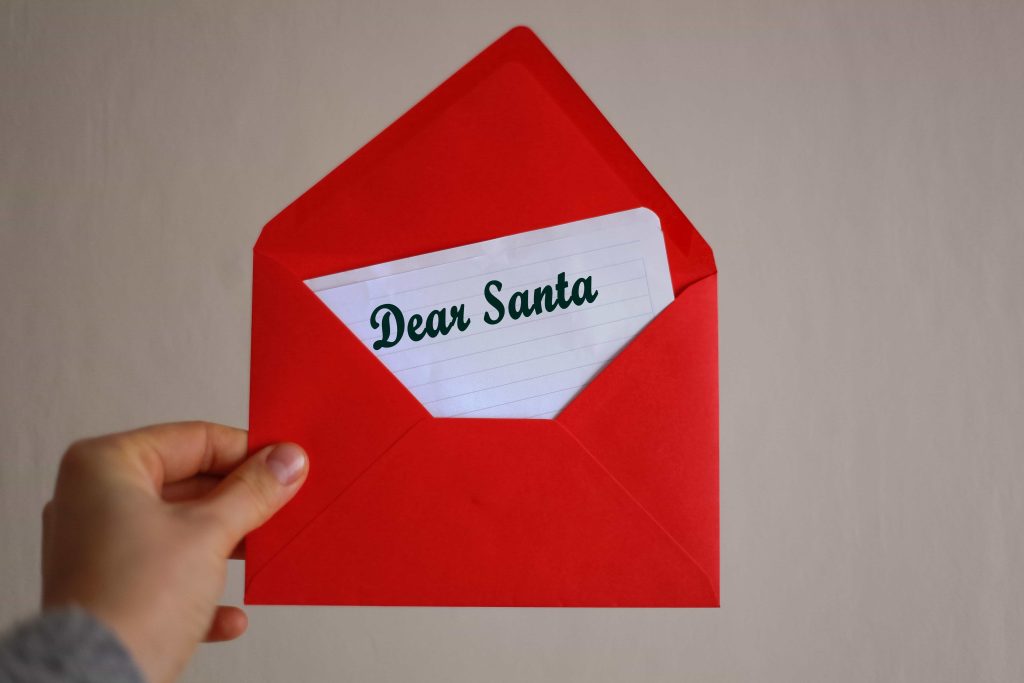
Mailing a letter to Santa isn’t complicated, but it does have a specific process if you want the reply to come back with an actual North Pole postmark. Skip a step, and the letter either doesn’t get a reply or arrives without the postmark that makes the whole thing feel real. Here’s the process in order, based on the USPS Operation Santa and Greetings from the North Pole programs.
What You Need Before You Start
You’ll need your child’s letter to Santa, written or dictated, a response letter written back as Santa (our guide on writing a letter to Santa walks through the wording if you’re stuck), two envelopes that fit one inside the other, two First-Class stamps, and your child’s mailing address written out correctly.
The Mailing Process
Have your child write their letter to Santa first. This is technically the letter Santa is “replying to,” even though you’re the one writing both sides of the exchange. Then write the reply as Santa, mentioning something specific from your child’s year so it doesn’t read as generic filler. Put your child’s original letter and Santa’s reply into the smaller envelope, and address it to your child at your home address, with the return address written as “Santa, North Pole.”
Attach a First-Class stamp to the smaller envelope’s upper right corner. Then place that sealed smaller envelope inside a larger envelope. This outer envelope is the one that actually travels through the postal system, and it needs to be addressed to: NORTH POLE POSTMARK POSTMASTER, 4141 POSTMARK DR, ANCHORAGE AK 99530-9998. Attach a second First-Class stamp to this outer envelope as well.
Mail it between roughly November 23 and December 1. Postal workers in Anchorage remove the inner envelope, apply the North Pole postmark, and send it back to your address, complete with the postmark that makes the whole thing convincing to a child who’s paying attention.
Why Timing Matters More Than People Expect
The North Pole postmark process depends on volunteer postal staff processing a genuinely high volume of letters during a short window every year. Mail early in that window and you’ve got a real shot at getting the reply back before Christmas Eve. Mail it on December 20 hoping for a December 24 return, and you’re likely setting yourself up for disappointment on both ends, your child waiting on mail that isn’t coming, and you scrambling for a backup plan two days before Christmas.
If your family is past the mailing window, or you’d rather not manage the two-envelope process at all, a personalized letter from Santa can still arrive with its own printed postmark design, on a timeline you control instead of one dictated by postal volume during the busiest mailing period of the year.
What Actually Goes Wrong With This Process
A few specific mistakes account for most of the letters that never make it back in time. The most common is addressing the inner envelope instead of the outer one to the Anchorage facility, which means the whole package gets delivered straight to your house instead of getting postmarked first. Another is forgetting the second stamp on the outer envelope, since it’s easy to assume one stamp covers the whole package when it doesn’t. And the third is simply mailing too late, which happens more than people expect given how compressed the first three weeks of December tend to get for most families.
If any of these go wrong, there generally isn’t a way to fix it after the fact. The letter either goes through the Anchorage postmark process or it doesn’t, so double-checking the outer envelope’s address and the two stamps before dropping it in the mailbox is worth the extra thirty seconds.
Where to Actually Mail It
Any collection box or post office counter works for mailing the outer envelope. You don’t need to alert your local post office ahead of time or fill out any special form. The address itself, and correct postage, is what routes it to the Anchorage processing facility rather than any special handling on your end. If you’re mailing several children’s letters in the same household, some families combine them into one outer envelope to save on postage, though each child’s individual letter still needs its own properly addressed and stamped inner envelope before going into the shared outer one.
When Mailing It Yourself Makes Sense, and When It Doesn’t
The USPS process is free beyond the cost of two stamps, and it gives families a genuinely authentic North Pole postmark through an official government program, which is hard to replicate any other way. It does take real effort: two envelopes, correct addressing on both, and a mailing window that’s easy to miss during an already busy December.
If the process itself is part of the appeal for your family, the hands-on tradition of it, mail it yourself. If the appeal is really the moment your child opens something that feels like it came from Santa, and the two-envelope logistics feel like one more thing competing for time you don’t have, a mailed letter from Santa handles the personalization, printing, and delivery without asking you to manage any of the postal steps yourself. Some families do both in different years, depending on how much bandwidth December happens to leave them.
What the Envelope Should Look Like When You’re Done
It helps to picture the finished package before you seal anything. The inner envelope should have your child’s name and your home address on the front, and “Santa, North Pole” written as the return address in the upper left corner, with a First-Class stamp in the upper right. That whole envelope, sealed, goes inside the larger outer envelope. The outer envelope carries the Anchorage address as the destination and its own separate First-Class stamp. Nothing about your home address needs to appear on the outer envelope at all, since the Anchorage facility is only handling the postmark step before sending the inner envelope on to you.
A mistake worth flagging here: some parents assume the outer envelope needs your return address written on it somewhere, in case anything goes wrong in transit. It doesn’t, and adding it doesn’t change how the process works. What matters is that the inner envelope, the one that actually reaches your child, has the correct home address on it before it goes inside the outer one.
How Long the Whole Round Trip Actually Takes
Once a letter reaches the Anchorage facility, the postmarking and return mailing typically takes a couple of weeks, which is exactly why the November 23 to December 1 window exists in the first place. Mail earlier in that window if your household tends to run behind on holiday tasks generally, since a letter that goes out on November 24 has considerably more buffer than one mailed on December 1 exactly. Given how much else tends to be happening in early December, families who know they’re likely to procrastinate are usually better off mailing in the first few days the window opens rather than waiting until the last possible date.
Frequently Asked Questions
What is the process for mailing a letter to Santa through USPS?
The process uses two envelopes: an inner envelope addressed to the child with a reply from Santa, sealed inside an outer envelope addressed to USPS’s Anchorage postmark facility.
Do I need two stamps to mail a letter to Santa through USPS?
Yes. One stamp goes on the inner envelope addressed to the child, and a second goes on the outer envelope addressed to the Anchorage facility.
Who is responsible for writing both letters in this process?
The parent or guardian writes both the child’s original letter and the reply as Santa, since the process requires both sides of the exchange to exist.
When should I mail the letter for a reply before Christmas?
USPS recommends mailing between roughly November 23 and December 1 to allow enough processing time for the postmarked reply to return before Christmas Eve.
What happens at the Anchorage facility once the letter arrives?
Postal workers remove the inner envelope, apply the North Pole postmark, and send it back to the child’s home address, typically within a couple of weeks.
What information does the inner envelope need?
The child’s name and home address as the recipient, with “Santa, North Pole” written as the return address in the upper left corner.
What’s the most common mistake families make with this process?
Addressing the inner envelope, rather than the outer one, to the Anchorage facility. This sends the whole package straight home without ever getting postmarked.
Can I mail more than one child’s letter in the same outer envelope?
Yes. Some families combine multiple children’s inner envelopes into a single outer envelope, though each inner envelope still needs its own correct address and stamp.
What if I miss the recommended mailing window?
The letter may still get processed, but it likely won’t return before Christmas. Families who miss the window often switch to a letter they control the timing on instead.
Is mailing a letter to Santa through USPS free?
It costs the price of two First-Class stamps, which is the only expense involved in the USPS reply program itself.
Does the reply letter need to be typed or can it be handwritten?
Either works for USPS’s process. If your child might recognize your handwriting, typing the reply removes that risk entirely.
How is mailing a letter different from just sending one to Santa’s general address?
Mailing through the two-envelope process produces an authentic Anchorage postmark. Addressing a letter to Santa’s general address is simpler but doesn’t include a formal reply.
Does this process guarantee a postmarked reply arrives in time?
No. Mailing within the recommended window improves the odds, but processing volume means an exact arrival date can’t be guaranteed.
What’s a lower-effort alternative to the two-envelope process?
A personalized or mailed letter from Santa can include a printed postmark design and arrive on a timeline the family controls, without managing two envelopes.
What should I check before sealing the envelopes?
Confirm the outer envelope carries the Anchorage address, both envelopes have their own stamp, and the inner envelope has the child’s correct home address.
Skip the Envelopes, Keep the Magic
If the two-envelope process sounds like more than this December has room for, a mailed letter from Santa still arrives in your child’s mailbox, personalized and ready, without you managing the postal steps yourself.